4 min(s) read time
Process Management as Foundation in the Heat Transition
- EIFFEL Projects


The heat transition requires speed. Municipalities face pressure to make choices, engage residents, and provide direction in a field that's still evolving. Technical solutions exist, but without a solid process, plans go nowhere. That's where the urgency emerges: careful process management becomes essential for municipalities that want to make real progress toward natural gas-free neighborhoods.
Legislation shifts, expectations change, and municipalities must keep moving. Esther Jansen, process manager at EIFFEL Projects, sees this daily in her projects.
Uncertainty around new legislation makes it hard for municipalities to pick up speed. But you have to move forward, because the challenge won't wait.
Esther Jansen - Process manager at EIFFEL Projects
On top of that comes participation. In practice, this proves to be one of the most sensitive parts of the heat transition. Municipalities continuously seek the balance between working carefully and taking action. Esther: "It's pioneering. There's no blueprint. You try things, sometimes they work and sometimes they don't. That requires courage from municipalities and flexibility from everyone in the project."
Why careful process work makes the difference
The energy transition is often seen as a technical challenge. But anyone standing in a neighborhood knows: it's also a social transition. Residents must make choices about their homes, often with emotions, concerns, and questions that go beyond technology. "Process managers can connect those worlds," Esther explains. "They look at interests, relationships, and timing. That helicopter view makes the process executable."
In projects she sees that process management adds value by:
- creating space to make good decisions
Not only from technical preferred routes, but informed by what's happening in the neighborhood. - offering room to experiment with approach and collaboration
Transitions require experimentation and building further. - strengthening multidisciplinary collaboration
Precisely because process managers look beyond the content line, they stay focused on progress, support, and coherence.
Best practices uit De Maten: zorgvuldig en uitvoerbaar
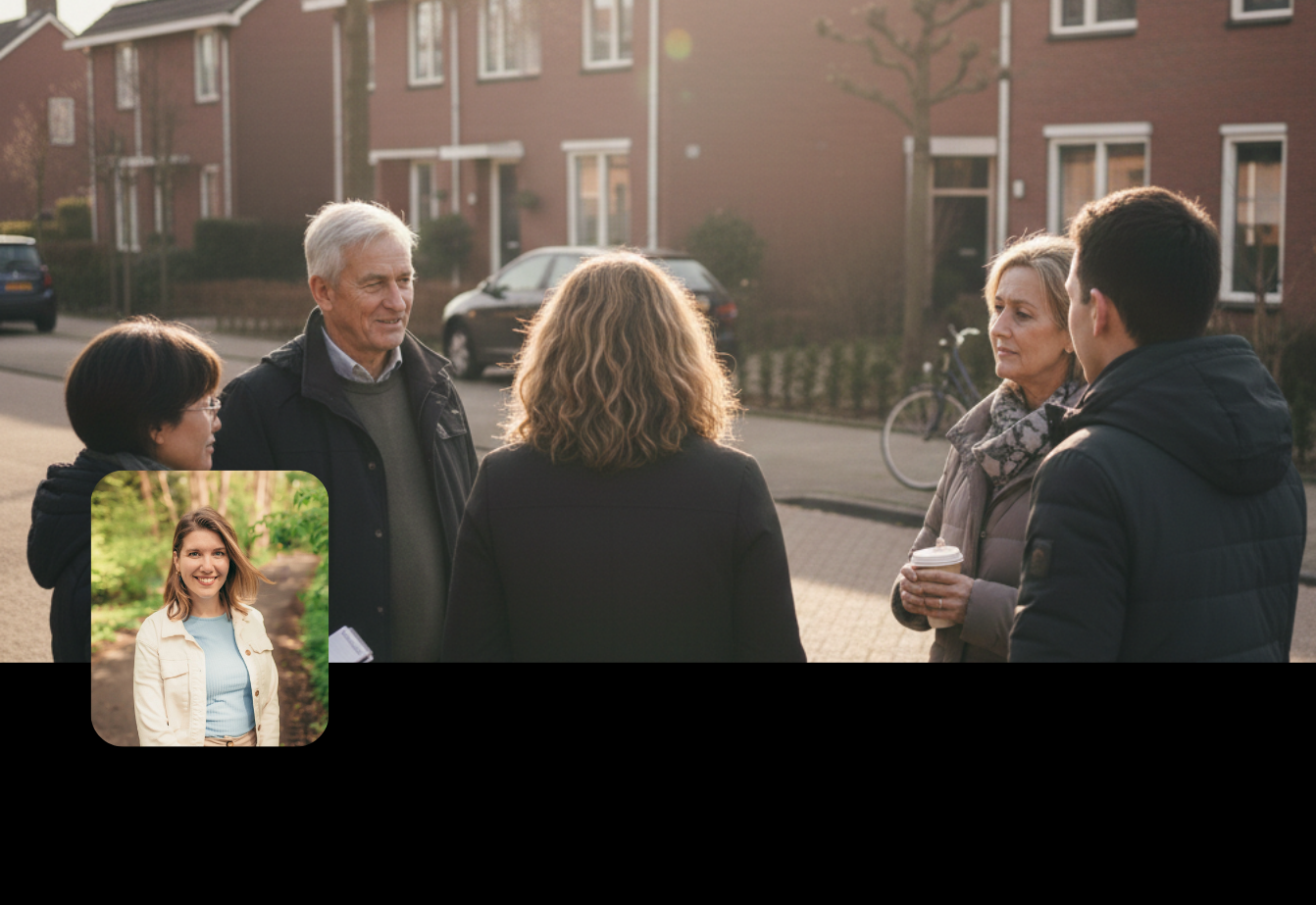
The De Maten neighborhood in Apeldoorn provides a clear example of how process management works in practice. The project team – including 4 Eiffel team members – worked integrally on technology, behavior, and participation. Esther: "We were literally in the neighborhood: street conversations, surveys, meetings, a think-along group. Because only by talking can you get a realistic picture of what's happening."
Several elements stood out:
- A think-along group as reflection of the neighborhood
Apeldoorn organized a broad group of residents from the neighborhood who thought along structurally. This brought wishes, concerns, and ideas from the neighborhood directly to the table. This gave the project team strength in the decisions they had to make later. - Participation in different forms
Conversations on the street, digital questionnaires, neighborhood evenings: by combining different instruments, the municipality reached residents in a way that suits them. The starting point was that everyone can participate in the process, in a way that fits them. This led to high engagement. - Consistent and clear communication
The process was central in all communication. By repeatedly explaining the starting points and steps of the process - even when the same questions returned - the neighborhood stayed connected. That predictability and clarity proved essential for understanding and trust. - A multidisciplinary team that operates as one unit
In De Maten, Eiffel team members and municipal colleagues visibly worked as a team. This created speed and an open way of working. "As Eiffel team members we could freely spar, keep each other sharp, and at the same time connect well with the municipal team," says Esther.
The result: a carefully completed process and a solid foundation under the preliminary choices for heat solutions that Apeldoorn is now discussing further with the neighborhood. The final plan follows next year, but the foundation is laid.
No standard approach for every neighborhood
It's important to emphasize that this extensive approach is not directly applicable in every neighborhood or municipality. The participation program in De Maten was intensive and time-consuming, because the neighborhood is large and the challenge complex. Esther: "This level of participation works here because it contributes to careful choices and fits with Apeldoorn's vision on participation. But it's not a standard recipe. Municipalities must determine per neighborhood what's realistic and necessary."
What this means for municipalities
The heat transition is becoming increasingly complex. Municipalities must make choices while the environment changes and pressure from residents and politics increases. In that dynamic, careful process management matters as an accelerator. It offers structure, overview, and continuous connection between parties.
For clients this means:
- Think about your vision on process management in the project.
Not as a closing item, but as a common thread through technology, policy, and participation. - Work in phases and realistically.
Not wanting everything at once, but preparing and testing decisions step by step. - Invest in a neighborhood-oriented approach.
No generic approach, but customization that fits residents, buildings, and local dynamics. - Deploy generalists alongside specialists.
The combination creates movement through the different disciplines.
Municipalities that find that balance take bigger steps in the heat transition. With choices that hold up and residents who know where they stand.