The CO2 Performance Ladder
Making the Netherlands sustainably future-proof. That's Team EIFFEL's mission. It forms the core of our services, where we use smart solutions to guide businesses and government organizations through the major challenges they face. At the same time, we focus just as actively on making our own operations more sustainable. To reinforce this commitment, we pursue certification on the CO2 Performance Ladder.
View our information on co2-prestatieladder.nl →
Three levels
With the introduction of Handbook 4.0 in 2025, the CO2 Performance Ladder has changed from an instrument with 5 levels to an instrument with three steps. The goal remains unchanged: to reduce CO2 emissions and energy consumption. Team EIFFEL achieved step 2 in May 2026.
Scopes that determine the objectives
Scope 1 is direct emissions caused by sources within the organization itself. This concerns the company's own building, transport, and production-related activities.
Scope 2 is indirect emissions.These are emissions arising from the generation of electricity, heat and cooling, and steam in installations that do not belong to the company itself.Scope 2 emissions can be reported based on the market-based and location-based methodologies:
- Market-based: A method to quantify the scope 2 emissions of an organization's electricity use that is based on the CO2 emissions of the energy supplier with whom the organization has a contractual agreement.
- Location-based: A method to quantify the scope 2 emissions of an organization's electricity use that is based on an average emission factor for electricity production within a defined location.
Scope 3 encompasses all indirect emissions that occur within the company's value chain. Examples include our suppliers and waste processing.
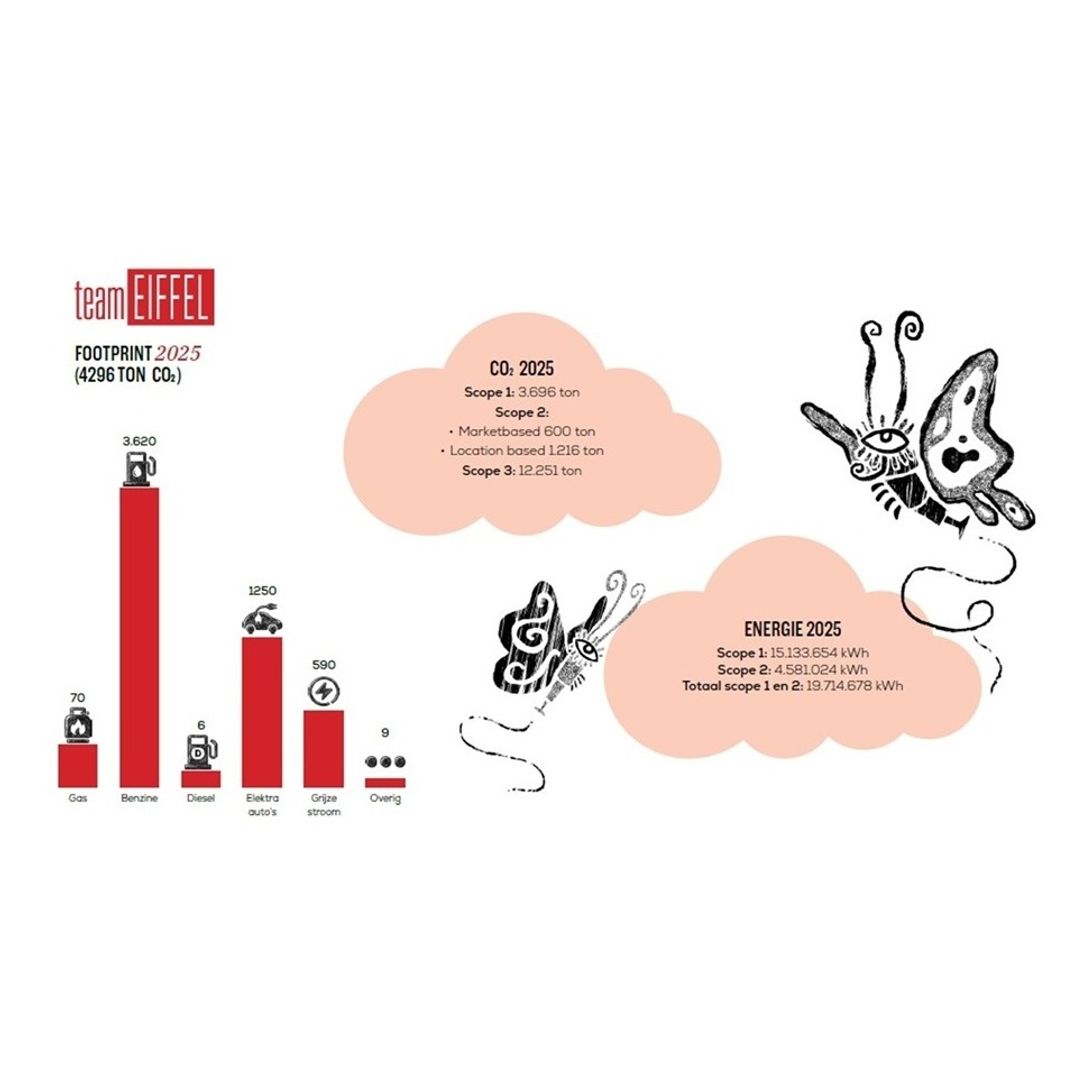
The image above shows Team EIFFEL's CO2 emissions and energy consumption for 2025. Within our footprint, fuel consumption from petrol cars accounts for the largest share (84%), followed by electricity consumption from our electric cars.We green this electricity consumption through the purchase of Guarantees of Origin (GOs).The measures Team EIFFEL is taking are aimed at reducing mobility emission streams.
Team EIFFEL's Scope 3 emissions amount to 12,251 tonnes of CO2.These emissions are based, among other things, on the expenditure Team EIFFEL incurs with our various suppliers.In collaboration with Procurement, we are investigating how these emissions can be reduced.
Main Objective
CO2:
Team EIFFEL aims to have 46% lower CO2 emissions in Scope 1 and 2 by 2028 compared to 2025. In Scope 1, this means a 56% reduction, while in Scope 2, it represents a 10% increase.
Energy:
Team EIFFEL aims to have 36% lower energy emissions in scope 1 and 2 by 2028 compared to 2025. In scope 1, this means a 49% reduction, while in scope 2, it represents an increase of 13%.
These objectives are relative to the number of FTEs. To achieve this objective, we have drawn up a number of significant measures.
Measures
- Rolling out a mobility scheme as part of the new mobility policy. Focus on public transport travel and electric driving.
- Collaborate more intensively with the mobility partner and other relevant direct relations regarding reporting and sustainability opportunities;
- Complete the phase-out of diesel cars;
- Develop and roll out a charging strategy;
- Investigate the installation of solar panels on the roof of our clubhouse in Arnhem;
- Draft a location policy.
Communication
We communicate our energy policy, CO2 footprint, and reduction targets to internal and external audiences every year, as part of our climate transition plan:
View or download our climate transition plan →
Cooperation
- Coalitie Anders Reizen
- Stichting Positieve Impact